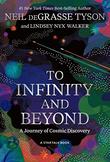
An enthusiastic, persuasive case to start probing outer space again.
Astrophysicist Tyson, the director of Hayden Planetarium at the American Museum of Natural History, delivers a forceful, cumulative argument for space exploration even in the face of a disastrous economy.
In this collection of articles and talks, the author investigates what space travel means to us as a species and, more specifically, what NASA means to America. Deploying an energetic tone, scattershot with clever twists and peculiar, entertaining factoids, Tyson handles the species half of the equation from the comic angle. That perspective is inclusive and humbling, open and encouraging of wonder, and the author finds in Earth a precious mote in the vastness, allowing readers to transcend the primal and celebrate great scientific laws to appreciate our place in the universe. It also helps us get past the jingoistic aspects of space exploration, for if NASA—the other half of Tyson’s concern—is driven by anything, it is military politics. “When science does advance, when discovery does unfold, when life on Earth does improve,” he writes, “they happen as an auxiliary benefit and not as a primary goal of NASA’s geopolitical mission statement.” But those auxiliary benefits are the critical, serendipitous fallout of the space program: GPS, cordless power tools, ear thermometers, household water filters, long-distance telecommunication devices, smoke detectors and much more. You can’t script the benefits; you have to have faith in the cross-pollinating splendors of science, and Tyson finds little evidence for this in the current Congress. If Tyson handles both the rarified and scientific justifications of continued space funding with aplomb, his economic reasoning falls short. One half a penny of each tax dollar sounds scant, but that leaves only 199 like-sized programs for the entire government.
An enthusiastic, persuasive case to start probing outer space again.Pub Date: Feb. 27, 2012
ISBN: 978-0-393-08210-4
Page Count: 384
Publisher: Norton
Review Posted Online: Nov. 5, 2011
Kirkus Reviews Issue: Nov. 15, 2011

Yes: it's high time for a de-romanticized, de-mythified, close-up retelling of the U.S. Space Program's launching—the inside story of those first seven astronauts.
But no: jazzy, jivey, exclamation-pointed, italicized Tom Wolfe "Mr. Overkill" hasn't really got the fight stuff for the job. Admittedly, he covers all the ground. He begins with the competitive, macho world of test pilots from which the astronauts came (thus being grossly overqualified to just sit in a controlled capsule); he follows the choosing of the Seven, the preparations for space flight, the flights themselves, the feelings of the wives; and he presents the breathless press coverage, the sudden celebrity, the glorification. He even throws in some of the technology. But instead of replacing the heroic standard version with the ring of truth, Wolfe merely offers an alternative myth: a surreal, satiric, often cartoony Wolfe-arama that, especially since there isn't a bit of documentation along the way, has one constantly wondering if anything really happened the way Wolfe tells it. His astronauts (referred to as "the brethren" or "The True Brothers") are obsessed with having the "right stuff" that certain blend of guts and smarts that spells pilot success. The Press is a ravenous fool, always referred to as "the eternal Victorian Gent": when Walter Cronkite's voice breaks while reporting a possible astronaut death, "There was the Press the Genteel Gent, coming up with the appropriate emotion. . . live. . . with no prompting whatsoever!" And, most off-puttingly, Wolfe presumes to enter the minds of one and all: he's with near-drowing Gus Grissom ("Cox. . . That face up there!—it's Cox. . . Cox knew how to get people out of here! . . . Cox! . . ."); he's with Betty Grissom angry about not staying at Holiday Inn ("Now. . . they truly owed her"); and, in a crude hatchet-job, he's with John Glenn furious at Al Shepard's being chosen for the first flight, pontificating to the others about their licentious behavior, or holding onto his self-image during his flight ("Oh, yes! I've been here before! And I am immune! I don't get into corners I can't get out of! . . . The Presbyterian Pilot was not about to foul up. His pipeline to dear Lord could not be clearer"). Certainly there's much here that Wolfe is quite right about, much that people will be interested in hearing: the P-R whitewash of Grissom's foul-up, the Life magazine excesses, the inter-astronaut tensions. And, for those who want to give Wolfe the benefit of the doubt throughout, there are emotional reconstructions that are juicily shrill.
But most readers outside the slick urban Wolfe orbit will find credibility fatally undermined by the self-indulgent digressions, the stylistic excesses, and the broadly satiric, anti-All-American stance; and, though The Right Stuff has enough energy, sass, and dirt to attract an audience, it mostly suggests that until Wolfe can put his subject first and his preening writing-persona second, he probably won't be a convincing chronicler of anything much weightier than radical chic.
Pub Date: Sept. 24, 1979
ISBN: 0312427565
Page Count: 370
Publisher: Farrar, Straus and Giroux
Review Posted Online: Oct. 13, 2011
Kirkus Reviews Issue: Sept. 1, 1979

BOOK TO SCREEN

A quirky wonder of a book.
A Peabody Award–winning NPR science reporter chronicles the life of a turn-of-the-century scientist and how her quest led to significant revelations about the meaning of order, chaos, and her own existence.
Miller began doing research on David Starr Jordan (1851-1931) to understand how he had managed to carry on after the 1906 San Francisco earthquake destroyed his work. A taxonomist who is credited with discovering “a full fifth of fish known to man in his day,” Jordan had amassed an unparalleled collection of ichthyological specimens. Gathering up all the fish he could save, Jordan sewed the nameplates that had been on the destroyed jars directly onto the fish. His perseverance intrigued the author, who also discusses the struggles she underwent after her affair with a woman ended a heterosexual relationship. Born into an upstate New York farm family, Jordan attended Cornell and then became an itinerant scholar and field researcher until he landed at Indiana University, where his first ichthyological collection was destroyed by lightning. In between this catastrophe and others involving family members’ deaths, he reconstructed his collection. Later, he was appointed as the founding president of Stanford, where he evolved into a Machiavellian figure who trampled on colleagues and sang the praises of eugenics. Miller concludes that Jordan displayed the characteristics of someone who relied on “positive illusions” to rebound from disaster and that his stand on eugenics came from a belief in “a divine hierarchy from bacteria to humans that point[ed]…toward better.” Considering recent research that negates biological hierarchies, the author then suggests that Jordan’s beloved taxonomic category—fish—does not exist. Part biography, part science report, and part meditation on how the chaos that caused Miller’s existential misery could also bring self-acceptance and a loving wife, this unique book is an ingenious celebration of diversity and the mysterious order that underlies all existence.
A quirky wonder of a book.Pub Date: April 14, 2020
ISBN: 978-1-5011-6027-1
Page Count: 224
Publisher: Simon & Schuster
Review Posted Online: Jan. 1, 2020
Kirkus Reviews Issue: Feb. 1, 2020
© Copyright 2024 Kirkus Media LLC. All Rights Reserved.
Follow
Popular in this Genre

We can’t wait for you to join Kirkus!
It’s free and takes less than 10 seconds!
Already have an account? Log in.
OR
 Sign in with Google
Trouble signing in? Retrieve credentials.
Welcome Back!
OR
Sign in with GoogleTrouble signing in? Retrieve credentials.


 bookshelf