


For what it’s worth, the thematic key would seem to be a Latin epigram, which translates, “You cannot see what you can see.”...
A puzzling novel that doesn’t reveal its secrets easily.
The latest from the renowned and prolific Carey (Parrot and Olivier in America, 2010, etc.) is too fanciful to pass as realism yet too inscrutable for parable or fable. Though all of it (or at least half of it) concerns a grieving woman’s attempt to re-engage with life after the death of her married lover, the prevailing spirit is comedic, even whimsical, rather than tragic. And the prevailing metaphor is that of clockwork, the mechanical precision of the museum where she serves as a curator, with “a considerable horological department, a world-famous collection of clocks and watches, automata and other wind-up engines,” a place where “for years I thought clockmaking must still any turmoil in one’s breast. I was so confident of my opinion, so completely wrong.” To keep protagonist and occasional narrator Catherine from going haywire, her supervisor assigns her an archival task: to study the diaries of a man who had commissioned a mechanical duck for his ailing son more than a century earlier. Some chapters are all Catherine, some are from the diaries of Henry and his adventures with the mechanical duck, and some mix the two, though the reader must make leaps of conjecture to connect the writing of Henry and the response from Catherine. Then the plot thickens, as it appears that the circumstances surrounding her affair were more complicated than Catherine had realized, and she comes to suspect that the pages she reads were written specifically for her: “He anticipated someone would watch him through the wormhole, that was clear. He wrote for that person.” While reading about the attempts to construct a mechanical duck that would appear animated, practically alive, Catherine feels herself turning into a machine: “Ingest, I thought, digest, excrete, repeat.”
For what it’s worth, the thematic key would seem to be a Latin epigram, which translates, “You cannot see what you can see.” It’s a novel that will amuse or challenge some and frustrate others.Pub Date: May 12, 2012
ISBN: 978-0-307-59271-2
Page Count: 288
Publisher: Knopf
Review Posted Online: April 15, 2012
Kirkus Reviews Issue: May 1, 2012

Characters flip between bottomless self-regard and pitiless self-loathing while, as late as the second-to-last chapter, yet...
Four Chicago sisters anchor a sharp, sly family story of feminine guile and guilt.
Newcomer Lombardo brews all seven deadly sins into a fun and brimming tale of an unapologetically bougie couple and their unruly daughters. In the opening scene, Liza Sorenson, daughter No. 3, flirts with a groomsman at her sister’s wedding. “There’s four of you?” he asked. “What’s that like?” Her retort: “It’s a vast hormonal hellscape. A marathon of instability and hair products.” Thus begins a story bristling with a particular kind of female intel. When Wendy, the oldest, sets her sights on a mate, she “made sure she left her mark throughout his house—soy milk in the fridge, box of tampons under the sink, surreptitious spritzes of her Bulgari musk on the sheets.” Turbulent Wendy is the novel’s best character, exuding a delectable bratty-ness. The parents—Marilyn, all pluck and busy optimism, and David, a genial family doctor—strike their offspring as impossibly happy. Lombardo levels this vision by interspersing chapters of the Sorenson parents’ early lean times with chapters about their daughters’ wobbly forays into adulthood. The central story unfurls over a single event-choked year, begun by Wendy, who unlatches a closed adoption and springs on her family the boy her stuffy married sister, Violet, gave away 15 years earlier. (The sisters improbably kept David and Marilyn clueless with a phony study-abroad scheme.) Into this churn, Lombardo adds cancer, infidelity, a heart attack, another unplanned pregnancy, a stillbirth, and an office crush for David. Meanwhile, youngest daughter Grace perpetrates a whopper, and “every day the lie was growing like mold, furring her judgment.” The writing here is silky, if occasionally overwrought. Still, the deft touches—a neighborhood fundraiser for a Little Free Library, a Twilight character as erotic touchstone—delight. The class calibrations are divine even as the utter apolitical whiteness of the Sorenson world becomes hard to fathom.
Characters flip between bottomless self-regard and pitiless self-loathing while, as late as the second-to-last chapter, yet another pleasurable tendril of sisterly malice uncurls.Pub Date: June 25, 2019
ISBN: 978-0-385-54425-2
Page Count: 544
Publisher: Doubleday
Review Posted Online: March 3, 2019
Kirkus Reviews Issue: March 15, 2019

SEEN & HEARD
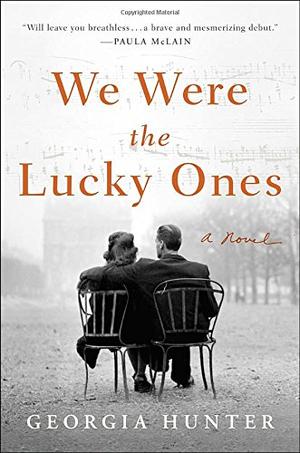
Too beholden to sentimentality and cliché, this novel fails to establish a uniquely realized perspective.
Hunter’s debut novel tracks the experiences of her family members during the Holocaust.
Sol and Nechuma Kurc, wealthy, cultured Jews in Radom, Poland, are successful shop owners; they and their grown children live a comfortable lifestyle. But that lifestyle is no protection against the onslaught of the Holocaust, which eventually scatters the members of the Kurc family among several continents. Genek, the oldest son, is exiled with his wife to a Siberian gulag. Halina, youngest of all the children, works to protect her family alongside her resistance-fighter husband. Addy, middle child, a composer and engineer before the war breaks out, leaves Europe on one of the last passenger ships, ending up thousands of miles away. Then, too, there are Mila and Felicia, Jakob and Bella, each with their own share of struggles—pain endured, horrors witnessed. Hunter conducted extensive research after learning that her grandfather (Addy in the book) survived the Holocaust. The research shows: her novel is thorough and precise in its details. It’s less precise in its language, however, which frequently relies on cliché. “You’ll get only one shot at this,” Halina thinks, enacting a plan to save her husband. “Don’t botch it.” Later, Genek, confronting a routine bit of paperwork, must decide whether or not to hide his Jewishness. “That form is a deal breaker,” he tells himself. “It’s life and death.” And: “They are low, it seems, on good fortune. And something tells him they’ll need it.” Worse than these stale phrases, though, are the moments when Hunter’s writing is entirely inadequate for the subject matter at hand. Genek, describing the gulag, calls the nearest town “a total shitscape.” This is a low point for Hunter’s writing; elsewhere in the novel, it’s stronger. Still, the characters remain flat and unknowable, while the novel itself is predictable. At this point, more than half a century’s worth of fiction and film has been inspired by the Holocaust—a weighty and imposing tradition. Hunter, it seems, hasn’t been able to break free from her dependence on it.
Too beholden to sentimentality and cliché, this novel fails to establish a uniquely realized perspective.Pub Date: Feb. 14, 2017
ISBN: 978-0-399-56308-9
Page Count: 416
Publisher: Viking
Review Posted Online: Nov. 21, 2016
Kirkus Reviews Issue: Dec. 1, 2016

BOOK TO SCREEN
© Copyright 2024 Kirkus Media LLC. All Rights Reserved.
Follow
Popular in this Genre

We can’t wait for you to join Kirkus!
It’s free and takes less than 10 seconds!
Already have an account? Log in.
OR
 Sign in with Google
Trouble signing in? Retrieve credentials.
Welcome Back!
OR
Sign in with GoogleTrouble signing in? Retrieve credentials.


 bookshelf


