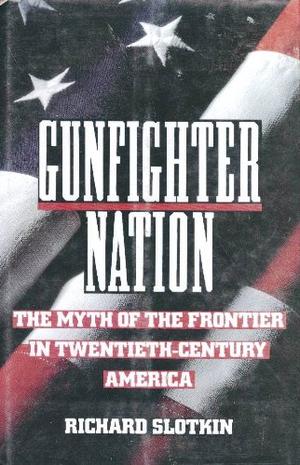

Concluding a trilogy that began with Regeneration Through Violence (1973) and The Fatal Environment (1985), Slotkin (English/Wesleyan Univ.) now offers a subtle and wide-ranging examination how America's fascination with the frontier has affected its culture and politics in this century. As used by Slotkin, ``myth'' means not a falsehood but a story derived from history that expresses a people's ideology. Beginning with Frederick Jackson Turner's landmark 1893 address on the closing of the frontier, Slotkin relates how Americans have used the unusually resonant myth of the West to explain ongoing issues of the present. Two works that helped establish the myth were Theodore Roosevelt's history The Winning of the West and Owen Wister's novel The Virginian, which pictured an Anglo-Saxon managerial elite toughened by exposure to remorseless ``savage wars'' against enemies, red-skinned and otherwise. Slotkin skillfully traces how the myth was used against the upstart labor movement, anti-imperialists, immigrants, and blacks. Although such media or genres as Buffalo Bill's Wild West show, the dime-stock novel, and the formula fiction of Dashiell Hammett, Zane Grey, and Edgar Rice Burroughs are explored here, much of the book is given over to a searching analysis of crucial western films like Stagecoach, Shane, The Searchers, Vera Cruz, and The Wild Bunch. Allowing for Slotkin's occasional lapses into academese, overemphasis of the western's influence (e.g., the WW II combat film is interpreted in light of ``the savage war,'' as if wars by their nature weren't), and oddly perfunctory nod to recent works such as Lonesome Dove and Dances With Wolves, the reader will get a provocative summary of how Americans from JFK on the left to Ronald Reagan on the right have exploited the power of the myth of the West. Intellectual history at its most stimulating—teeming with insights into American violence, politics, class, and race.
Pub Date: Dec. 2, 1992
ISBN: 0-689-12163-6
Page Count: 704
Publisher: Atheneum
Review Posted Online: May 19, 2010
Kirkus Reviews Issue: Oct. 15, 1992

Dogged original research and superb narrative skills come together in this gripping account of pitiless evil.
Greed, depravity, and serial murder in 1920s Oklahoma.
During that time, enrolled members of the Osage Indian nation were among the wealthiest people per capita in the world. The rich oil fields beneath their reservation brought millions of dollars into the tribe annually, distributed to tribal members holding "headrights" that could not be bought or sold but only inherited. This vast wealth attracted the attention of unscrupulous whites who found ways to divert it to themselves by marrying Osage women or by having Osage declared legally incompetent so the whites could fleece them through the administration of their estates. For some, however, these deceptive tactics were not enough, and a plague of violent death—by shooting, poison, orchestrated automobile accident, and bombing—began to decimate the Osage in what they came to call the "Reign of Terror." Corrupt and incompetent law enforcement and judicial systems ensured that the perpetrators were never found or punished until the young J. Edgar Hoover saw cracking these cases as a means of burnishing the reputation of the newly professionalized FBI. Bestselling New Yorker staff writer Grann (The Devil and Sherlock Holmes: Tales of Murder, Madness, and Obsession, 2010, etc.) follows Special Agent Tom White and his assistants as they track the killers of one extended Osage family through a closed local culture of greed, bigotry, and lies in pursuit of protection for the survivors and justice for the dead. But he doesn't stop there; relying almost entirely on primary and unpublished sources, the author goes on to expose a web of conspiracy and corruption that extended far wider than even the FBI ever suspected. This page-turner surges forward with the pacing of a true-crime thriller, elevated by Grann's crisp and evocative prose and enhanced by dozens of period photographs.
Dogged original research and superb narrative skills come together in this gripping account of pitiless evil.Pub Date: April 18, 2017
ISBN: 978-0-385-53424-6
Page Count: 352
Publisher: Doubleday
Review Posted Online: Feb. 1, 2017
Kirkus Reviews Issue: Feb. 15, 2017

BOOK TO SCREEN

BOOK TO SCREEN

BOOK TO SCREEN

The author's youthfulness helps to assure the inevitable comparison with the Anne Frank diary although over and above the...
Elie Wiesel spent his early years in a small Transylvanian town as one of four children.
He was the only one of the family to survive what Francois Maurois, in his introduction, calls the "human holocaust" of the persecution of the Jews, which began with the restrictions, the singularization of the yellow star, the enclosure within the ghetto, and went on to the mass deportations to the ovens of Auschwitz and Buchenwald. There are unforgettable and horrifying scenes here in this spare and sombre memoir of this experience of the hanging of a child, of his first farewell with his father who leaves him an inheritance of a knife and a spoon, and of his last goodbye at Buchenwald his father's corpse is already cold let alone the long months of survival under unconscionable conditions.
Pub Date: Jan. 16, 2006
ISBN: 0374500010
Page Count: 120
Publisher: Hill & Wang
Review Posted Online: Oct. 7, 2011
Kirkus Reviews Issue: Jan. 15, 2006
© Copyright 2024 Kirkus Media LLC. All Rights Reserved.
Follow
Popular in this Genre

We can’t wait for you to join Kirkus!
It’s free and takes less than 10 seconds!
Already have an account? Log in.
OR
 Sign in with Google
Trouble signing in? Retrieve credentials.
Welcome Back!
OR
Sign in with GoogleTrouble signing in? Retrieve credentials.



 bookshelf