Light and sweet as a bonbon, this little confection of a book is delicious.
Can the gift of a perfect book transform a person’s life?
Juliette, a whimsical Parisian, leads a life far too dull for her magical spirit. She has an ordinary office job in real estate and dates men who are positively yawnworthy. Her love of literature and her active imagination, however, set her on a path to becoming a matchmaker between books and readers. Juliette lives in an almost-alternate reality where passengers on the Métro are actually reading paper books rather than texting friends, swiping Tinder, or even reading e-books. She is intrigued by the man in the green hat who makes his way through an entomology textbook and the hopeless romantic who sobs at page 247 of every book she reads. One morning, Juliette instinctively exits the Métro a few stops early on her commute to find herself at the quirky Books Unlimited, where she meets Soliman and his young daughter, Zaide. There, she is recruited as a book passeur; her mission is to follow strangers and observe their lives in order to give them the gift of the perfect book for that moment in their lives. Part charming stalker, part literary pharmacist, Juliette is more fulfilled as passeur than real estate agent and dives deeper into this secret realm of bibliophilic cupids. With a cast of characters reminiscent of the French film Amélie, Féret-Fleury creates a world that is delightful and enchanting. As she flits about this new universe, Juliette discovers that the life she may change the most is her own. This is the author's first book to appear in English, and it's been deftly translated to maintain the lyrical writing of the original French text.
Light and sweet as a bonbon, this little confection of a book is delicious.Pub Date: Oct. 8, 2019
ISBN: 978-1-250-31542-7
Page Count: 192
Publisher: Flatiron Books
Review Posted Online: Sept. 1, 2019
Kirkus Reviews Issue: Sept. 15, 2019

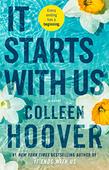
Packed with riveting drama and painful truths, this book powerfully illustrates the devastation of abuse—and the strength of...
Hoover’s (November 9, 2015, etc.) latest tackles the difficult subject of domestic violence with romantic tenderness and emotional heft.
At first glance, the couple is edgy but cute: Lily Bloom runs a flower shop for people who hate flowers; Ryle Kincaid is a surgeon who says he never wants to get married or have kids. They meet on a rooftop in Boston on the night Ryle loses a patient and Lily attends her abusive father’s funeral. The provocative opening takes a dark turn when Lily receives a warning about Ryle’s intentions from his sister, who becomes Lily’s employee and close friend. Lily swears she’ll never end up in another abusive home, but when Ryle starts to show all the same warning signs that her mother ignored, Lily learns just how hard it is to say goodbye. When Ryle is not in the throes of a jealous rage, his redeeming qualities return, and Lily can justify his behavior: “I think we needed what happened on the stairwell to happen so that I would know his past and we’d be able to work on it together,” she tells herself. Lily marries Ryle hoping the good will outweigh the bad, and the mother-daughter dynamics evolve beautifully as Lily reflects on her childhood with fresh eyes. Diary entries fancifully addressed to TV host Ellen DeGeneres serve as flashbacks to Lily’s teenage years, when she met her first love, Atlas Corrigan, a homeless boy she found squatting in a neighbor’s house. When Atlas turns up in Boston, now a successful chef, he begs Lily to leave Ryle. Despite the better option right in front of her, an unexpected complication forces Lily to cut ties with Atlas, confront Ryle, and try to end the cycle of abuse before it’s too late. The relationships are portrayed with compassion and honesty, and the author’s note at the end that explains Hoover’s personal connection to the subject matter is a must-read.
Packed with riveting drama and painful truths, this book powerfully illustrates the devastation of abuse—and the strength of the survivors.Pub Date: Aug. 2, 2016
ISBN: 978-1-5011-1036-8
Page Count: 320
Publisher: Atria
Review Posted Online: May 30, 2016
Kirkus Reviews Issue: June 15, 2016

SEEN & HEARD

SEEN & HEARD

Characters flip between bottomless self-regard and pitiless self-loathing while, as late as the second-to-last chapter, yet...
Four Chicago sisters anchor a sharp, sly family story of feminine guile and guilt.
Newcomer Lombardo brews all seven deadly sins into a fun and brimming tale of an unapologetically bougie couple and their unruly daughters. In the opening scene, Liza Sorenson, daughter No. 3, flirts with a groomsman at her sister’s wedding. “There’s four of you?” he asked. “What’s that like?” Her retort: “It’s a vast hormonal hellscape. A marathon of instability and hair products.” Thus begins a story bristling with a particular kind of female intel. When Wendy, the oldest, sets her sights on a mate, she “made sure she left her mark throughout his house—soy milk in the fridge, box of tampons under the sink, surreptitious spritzes of her Bulgari musk on the sheets.” Turbulent Wendy is the novel’s best character, exuding a delectable bratty-ness. The parents—Marilyn, all pluck and busy optimism, and David, a genial family doctor—strike their offspring as impossibly happy. Lombardo levels this vision by interspersing chapters of the Sorenson parents’ early lean times with chapters about their daughters’ wobbly forays into adulthood. The central story unfurls over a single event-choked year, begun by Wendy, who unlatches a closed adoption and springs on her family the boy her stuffy married sister, Violet, gave away 15 years earlier. (The sisters improbably kept David and Marilyn clueless with a phony study-abroad scheme.) Into this churn, Lombardo adds cancer, infidelity, a heart attack, another unplanned pregnancy, a stillbirth, and an office crush for David. Meanwhile, youngest daughter Grace perpetrates a whopper, and “every day the lie was growing like mold, furring her judgment.” The writing here is silky, if occasionally overwrought. Still, the deft touches—a neighborhood fundraiser for a Little Free Library, a Twilight character as erotic touchstone—delight. The class calibrations are divine even as the utter apolitical whiteness of the Sorenson world becomes hard to fathom.
Characters flip between bottomless self-regard and pitiless self-loathing while, as late as the second-to-last chapter, yet another pleasurable tendril of sisterly malice uncurls.Pub Date: June 25, 2019
ISBN: 978-0-385-54425-2
Page Count: 544
Publisher: Doubleday
Review Posted Online: March 3, 2019
Kirkus Reviews Issue: March 15, 2019

SEEN & HEARD
© Copyright 2024 Kirkus Media LLC. All Rights Reserved.
Follow
Popular in this Genre

We can’t wait for you to join Kirkus!
It’s free and takes less than 10 seconds!
Already have an account? Log in.
OR
 Sign in with Google
Trouble signing in? Retrieve credentials.
Welcome Back!
OR
Sign in with GoogleTrouble signing in? Retrieve credentials.


 bookshelf