


To read Jim Fielding’s resume is to stroll a path of some of the most coveted leadership positions of the past 30 years, including C-level roles at Disney, DreamWorks, the Gap, and 20th Century Fox. He’s directed multinational creative teams, developed global brand-building strategies, and navigated some of the most shark-infested corporate waters in the world. An exciting career, but not always an easy one, particularly for an out gay man. In his new book, All Pride, No Ego: A Queer Executive’s Journey to Living and Leading Authentically (Wiley, Aug. 15), Fielding looks back at the road he’s traveled—sometimes smooth, sometimes rough—to mine lessons for today’s leaders, and tomorrow’s. We spoke with Fielding, who lives in Georgia, by video chat; our conversation has been edited for length and clarity.
What inspired you to write All Pride, No Ego?
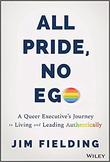 In my 30-plus years in big corporate media, I wasn’t allowed to have an opinion that wasn’t on the company line. When you’re in the C-suite, you always have to think, well, what’s going to be the impact on the company if I say this? During the pandemic, I started to get more political, more vocal in my online posts, and then publishers started reaching out. My editor at Wiley said, “I think you should write the book that 56-year-old Jim wishes he had when he was starting his career at 26.” When I was struggling with coming out early in my career there wasn’t a book like this for me to go to, to say it’s actually going to be OK, and here’s some advice. I particularly want to reach young leaders who think they don’t see themselves in the C-suite, or who don’t see a place for themselves in corporate life. I want them to know that there is a place. It may not be easy, but it’s there.
We moved the publication date up [from 2024] because of what’s happening in the world, the insane amount of anti-LGBTQ+ legislation. The far right has organized their machine, and it’s been so successful. It’s a form of bullying, and when you’re getting bullied you have to stand up. So the time is now. We have to tell our stories, and we have to own our stories. We have to say, “Hey, I was born this way, I’m proud of myself, this is who I am, and I’m going to be more productive in society, and more productive for your business, if I’m allowed to be my authentic self.”
One refrain you return to often is “don’t dim your light.” But as a gay person in a mostly straight corporate environment, you do have to manage your light.
Gay people are very good at reading a room. We have to be. When we walk into a dinner party or a bar or a conference, we ask, OK, is this a safe environment? We’ve been preparing our whole lives to read a situation, to prepare properly, for safety. But it is tiring. So the other point I make is, please don’t modulate your life outside of work. Hopefully somewhere in your life you get to be fully you. If not, there are mental and physical strains that come from that. I went through it: Migraines, stomach ailments. It was super hard, and it was all stress.
Your book is, on balance, optimistic. But you don’t shy away from sharing difficult anecdotes, too. What’s the value of being vulnerable in print?
Leaving Disney [in 2012] was one of the lowest points in my life. I loved that job, but I was working for a boss who was bullying me. I was a mess. I became horrible to my partner. I cut myself off from friends and family. And I misplayed corporate politics; I got screwed. But people need to know, this is corporate America. It’s not the land of milk and honey. Young leaders need to understand this. I had to share these experiences, because otherwise I’m not being authentic.
When does the need for personal authenticity become a wider responsibility? In other words, is there a point on a career path when it becomes incumbent on a leader who is queer to set an example?
For me, it started circa 2004, when I became a senior vice president at Disney and I was managing a global team of 200-300 people. At that point I had earned the title and responsibility, and I was comfortable. I was working for a boss who had my back. I could then start to allow people into my personal life. It wasn’t like I was coming out, it was like I was inviting them into my life. Talking about my weekend with my partner, for example. It’s a cliché, but representation matters. You have to be visible for the next generation, so that they see people who look and sound like them.
[But] I would never advocate being the kind of leader where you’re only hiring clones of yourself. If I hired 50 of me, we would kill each other. You don’t need a bunch of Type A control freaks. Everyone has a story and a place. I will never be successful if I can only manage gay people. I have to be able to manage everyone.
Lately, it seems brands are having a harder and harder time dealing with LGBTQ+ issues publicly. We’ve seen many missteps this year, with Bud Light, Starbucks, and other brands. What should corporations be doing?
Increasingly, people look to companies and corporations for guidance. I think what’s gone on this summer is insane. Is Starbucks our ally or not? Is Target our ally or not? The younger generation is extremely aware of corporate policies and what they’re doing about the environment, about human rights, about social justice. You’re going to lose customers if you’re not open and visible about what your stances are.
Bob Iger [CEO of the Walt Disney Company] is fighting this fight with [Florida governor] Ron DeSantis. Besides the fact that Disney has an incredible legal department, they’re on the right side of this. They’re arguing for sanity. Knowing Bob, much of it is coming from his moral fiber. As the CEO of one of the world’s largest companies, he is willing to use his position to advocate for what is right, and I admire that.
Tucker Shaw is a journalist and the author of When You Call My Name.


